
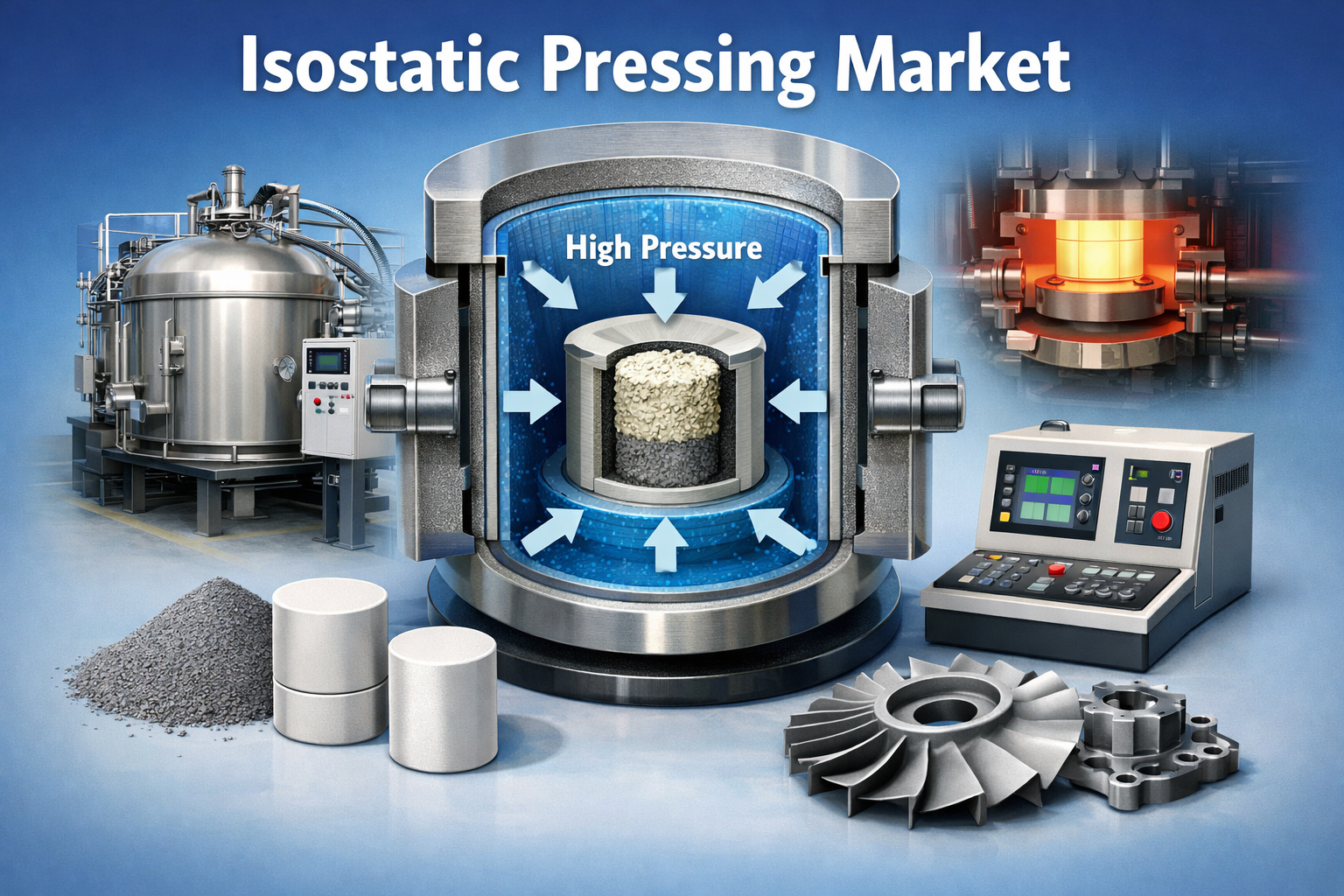
The isostatic pressing industry is experiencing steady expansion as global manufacturers increasingly adopt advanced material compaction technologies to achieve higher strength, precision, and reliability in engineered components. The Isostatic Pressing Market Size was valued at USD 7.52 Billion in 2023 and is expected to reach USD 13.66 Billion by 2032, growing at a CAGR of 6.86% over the forecast period 2024–2032. This growth reflects rising demand for high-performance materials across aerospace, automotive, medical, electronics, and energy sectors, where uniform density and superior mechanical properties are critical. As industries move toward more complex designs and stricter quality standards, isostatic pressing is emerging as a preferred manufacturing solution.
The Isostatic Pressing Market growth is primarily driven by its ability to apply uniform pressure in all directions, resulting in components with consistent density, minimal defects, and enhanced structural integrity. This advantage makes the technology especially suitable for processing metals, ceramics, and composite materials used in high-stress and high-temperature environments. The increasing focus on precision manufacturing and near-net-shape production is encouraging companies to shift away from traditional forming methods toward isostatic pressing techniques. As manufacturers aim to reduce material waste and improve product performance, the adoption of both cold isostatic pressing (CIP) and hot isostatic pressing (HIP) continues to rise globally.
A major factor supporting market expansion is the growing demand from the aerospace and defense industry. Aircraft engines, turbine blades, structural components, and space applications require materials with exceptional fatigue resistance and mechanical strength. Hot isostatic pressing plays a vital role in eliminating internal porosity and improving the durability of critical aerospace parts. With increasing air travel, defense modernization programs, and investments in space exploration, aerospace manufacturers are steadily increasing their reliance on isostatic pressing to meet stringent safety and performance requirements.
The automotive sector is also contributing significantly to market growth as manufacturers seek lightweight yet strong components to meet fuel efficiency and emission regulations. Isostatic pressing enables the production of high-density metal parts that combine strength with reduced weight, making it ideal for gears, transmission components, and structural elements. Additionally, the rise of electric vehicles has created new opportunities for isostatic pressing in battery components and powertrain systems, where dimensional accuracy and material reliability are essential for long-term performance.
Healthcare and medical device manufacturing represent another important growth avenue for the isostatic pressing market. The technology is widely used to produce biocompatible implants, orthopedic joints, dental components, and surgical instruments. Hot isostatic pressing enhances the mechanical strength and lifespan of medical implants while ensuring consistency and safety. As global populations age and demand for advanced medical treatments increases, the need for high-quality, defect-free medical components is expected to further drive adoption of isostatic pressing solutions.
Technological advancements are playing a key role in shaping the future of the market. Manufacturers are increasingly integrating automation, digital monitoring, and advanced control systems into isostatic pressing equipment to improve efficiency and repeatability. Innovations in pressure vessel design and process optimization are helping reduce cycle times and operational costs. Furthermore, the growing adoption of additive manufacturing is creating complementary demand, as many 3D-printed metal parts require hot isostatic pressing as a post-processing step to improve density and mechanical performance.
From a regional perspective, Asia Pacific is expected to witness strong growth due to rapid industrialization, expanding automotive production, and rising investments in aerospace and heavy manufacturing industries. Countries such as China, Japan, India, and South Korea are strengthening their manufacturing capabilities, which is accelerating demand for advanced material processing technologies. Meanwhile, North America and Europe continue to hold significant market shares due to established aerospace, defense, and medical sectors, along with strong research and development activities in advanced materials.
Despite its positive outlook, the isostatic pressing market faces certain challenges. High initial equipment costs and energy-intensive operations, particularly for hot isostatic pressing systems, can limit adoption among small and medium-sized manufacturers. Additionally, operating high-pressure systems requires skilled personnel and strict safety measures, which can add to operational complexity. However, ongoing technological improvements and increasing economies of scale are expected to gradually reduce these barriers over time.
In conclusion, the isostatic pressing market is positioned for sustained growth through 2032, supported by rising demand for high-performance materials, expanding industrial applications, and continuous technological innovation. With its proven ability to deliver superior material properties and precision, isostatic pressing will remain a critical manufacturing process for industries focused on quality, reliability, and long-term performance.